
Biography
Peipei Zhou is a Tenure-Track Assistant Professor at Brown University, School of Engineering. She leads the Customized Computer Architecture Research Lab at Brown University. Dr. Zhou received her B.S. in Electrical and Computer Engineering from Southeast University, Chien-Shiung Wu Honor College in 2012, her M.S. in Electrical and Computer Engineering in 2014, and her Ph.D. in Computer Science in 2019, both from University of California, Los Angeles.
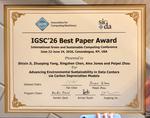
Zhou’s research focuses on creating Customized Computer Architecture and Programming Abstraction for Applications including Healthcare, e.g., Precision Medicine, and Artificial Intelligence. She is the recipient of the 2026 NSF CAREER Award 🏆. She has been selected for the 2026 National Academy of Engineering’s Grainger Foundation Frontiers of Engineering Symposium 🏆, recognizing her exceptional research and technical leadership among early-career engineers. She also received “Outstanding Recognition in Research” Award from UCLA Samueli School of Engineering in 2019 🏆. Her research has received the 2025 IEEE/ACM ICCAD 10-Year Retrospective Most Influential Paper Award 🏆, 2026 ACM International Green and Sustainable Computing (IGSC) Best Paper Award 🏆, and 2019 IEEE TCAD Donald O. Pederson Best Paper Award 🏆. Additional recognitions include 🏆2025 ACM/SIGDA FPGA Best Paper Nominee, 2024 IEEE IGSC Best Viewpoint Paper, 2023 ACM/IEEE IGSC Best Viewpoint Paper Finalist, the 2018 IEEE ISPASS Best Paper Nominee, and the 2018 IEEE/ACM ICCAD Best Paper Nominee🏆.
I’m actively recruiting PhD students and research interns! Self-motivated students with relevant research and project experience (compiler, GPU and FPGA programming, artificial intelligence algorithm and application development, etc.) are highly encouraged to contact me via email.
Download my CV.
Website at Brown
Researchers@Brown
Former Website at UCLA
- Application & Algorithm: Artificial Intelligence, Healthcare
- Abstraction: Programming, Modeling and Optimization
- Architecture: Heterogeneous Computing with FPGA, GPU, ASIC, NPU
-
PhD in Computer Science, 2019
University of California, Los Angeles
-
MSc in Electrical Engineering, 2014
University of California, Los Angeles
-
BSc in Electrical Engineering, 2012
Southeast University, Chien-Shiung Wu Honor College
Research Focus
Health & Artificial Intelligence
Software
Hardware
Experience
Responsibilities include:
- Tenure-Track Assistant Professor
- Computer Engineering Concentration Advisor
Responsibilities include:
- Tenure-Track Assistant Professor
Responsibilities include:
- High-Performance Convolution Neural Network Library for Deep Learning ASIC Acclerator
- Pre-silicon Architecture Exploration and Performance Modeling
- Post-silicon ASIC Bring-Up and System Software Optimization
Responsibilities include:
- Resource allocation and scheduling optimization for Genome Analysis Toolkit(GATK4) in the cloud.
- Cost-Optimal heterogeneous computing by orchestrating seas of datacenter scale resources including computing (CPUs+GPU+FPGA accelerators), storage (HDD, SSD, local disk)
Responsibilities include:
- Developed a scalable end-to-end tool to generate >2M grammar fixed (preposition, article and etc.) sentences from Wikipedia.
- Implemented LSTM-based neural network model for translation tasks
Responsibilities include:
- Implemented image compression algorithm in C++(software reference code) and also implemented hardware accelerator on FPGA
Honors
Recent Posts
Projects
Recent & Upcoming Talks

Featured Publications
As deep neural networks develop significantly more diverse andcomplex, achieving high performance and efficiency on complicatedDNN models faces pressing challenges. Modern DNN workloadsare increasingly diverse in operation types, tensor shapes, andexecution dependencies, making it difficult to sustain high hardwareefficiency across models. In addition, a generic accelerator oftenincurs substantial overhead when executing diverse workloads.
To address these problems, we propose DORA, an instruction-based overlay architecture that explicitly describes dataflow viaa proposed ISA, enabling fine-grained control of data movement,computation, and synchronization at the layer level. To supportflexibility while achieving high performance, DORA adopts a novelon-chip memory management and computation parallelism man-agement mechanism. DORA proposes a compilation frameworkthat can generate instructions for given DNN workloads after atwo-stage design space exploration. DORA framework also incorpo-rates a MILP-based and a heuristic-based search engine to generatethe schedule solution for different needs and constraints.
We prototype DORA on the AMD Versal VCK190 platform,demonstrating its deployability on existing reconfigurable systems.Experimental results show that DORA maintains stable efficiency,with less than 5% variation on a single vector processor acrossworkloads exhibiting up to 6× variation in operation counts. Com-pared to state-of-the-art accelerators, DORA consistently achieveshigher performance, delivering up to 5× throughput improvement.The heuristic-based scheduler further achieves up to 90% opti-mality under practical time constraints. DORA is open-sourcedat https://github.com/arc-research-lab/DORA.git.
Heterogeneous reconfigurable platforms with tensor cores, suchas AMD ACAP, are increasingly adopted for deep neural network(DNN) inference due to their high throughput and flexibility. How-ever, their suitability for microsecond-scale inference on small prob-lem sizes remains underexplored. In jet-tagging applications inhigh-energy physics, inefficient on-chip communication and largeinter-layer latency prevent existing frameworks from meeting the1-𝜇s latency budget. Moreover, hardware overheads such as syn-chronization and VLIW processor prologue are often overlooked,making it infeasible to optimize accelerators correctly. To addressthese problems, we propose µ-ORCA, a customized heterogeneousaccelerator framework for ultra-low-latency model inference. µ-ORCA enables direct inter-layer communication between DNN lay-ers on the AIE array, instead of using shared memory tiles or FPGAfabric. Moreover, a 512-bit/cycle cascade connection is applied in-stead of a 32-bit/cycle DMA connection. µ-ORCA also provides anoverhead-aware performance model that adapts to different NNlayer sizes, and conducts design space exploration to optimize end-to-end latency. µ-ORCA supports MLP and DeepSets models withnon-MM kernels, including bias, ReLU, and global aggregation onAIE. We evaluate µ-ORCA on the AMD ACAP VEK280 platform.Experimental results show that µ-ORCA achieves average latencyreduction of >1.70× and >1.83× compared with different state-of-the-art ACAP frameworks, and achieves 0.93 𝜇s latency for a 6-layerreal-world DeepSets model, satisfying the latency budget. We opensource µ-ORCA at https://github.com/arc-research-lab/u-ORCA.
Deep neural network (DNN) models are increasingly deployed in real-time, safety-critical systems such as autonomous vehicles, driving the need for specialized AI accelerators. However, most existing accelerators support only non-preemptive execution or limited preemptive scheduling at the coarse granularity of DNN layers. This restriction leads to frequent priority inversion due to the scarcity of preemption points, resulting in unpredictable execution behavior and, ultimately, system failure.
To address these limitations and improve the real-time performance of AI accelerators, we propose DERCA, a novel accelerator architecture that supports fine-grained, intra-layer flexible preemptive scheduling with cycle-level determinism. DERCA incorporates an on-chip Earliest Deadline First (EDF) scheduler to reduce both scheduling latency and variance, along with a customized dataflow design that enables intra-layer preemption points (PPs) while minimizing the overhead associated with preemption. Leveraging the limited preemptive task model, we perform a comprehensive predictability analysis of DERCA, enabling formal schedulability analysis and optimized placement of preemption points within the constraints of limited preemptive scheduling. We implement DERCA on the AMD ACAP VCK190 reconfigurable platform. Experimental results show that DERCA outperforms state-of-the-art designs using non-preemptive and layer-wise preemptive dataflows, with less than 5% overhead in worst-case execution time (WCET) and only 6% additional resource utilization. DERCA is open-sourced on GitHub: https://github.com/arc-research-lab/DERCA.
As AI continues to grow, modern applications are becoming more data- and compute-intensive, driving the development of specialized AI chips to meet these demands. One example is AMD’s AI Engine (AIE), a dedicated hardware system that includes a 2D array of high-frequency very-long instruction words (VLIW) vector processors to provide high computational throughput and reconfigurability. However, AIE’s specialized architecture presents tremendous challenges in programming and compiler optimization. Existing AIE programming frameworks lack a clean abstraction to represent multi-level parallelism in AIE; programmers have to figure out the parallelism within a kernel, manually do the partition, and assign sub-tasks to different AIE cores to exploit parallelism. These significantly lower the programming productivity. Furthermore, some AIE architectures include FPGAs to provide extra flexibility, but there is no unified intermediate representation (IR) that captures these architectural differences. As a result, existing compilers can only optimize the AIE portions of the code, overlooking potential FPGA bottlenecks and leading to suboptimal performance.
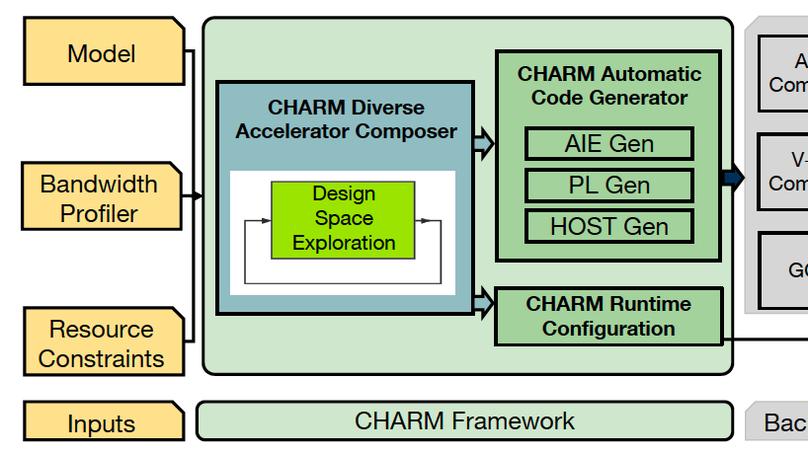
To address these limitations, we introduce ARIES, an agile multilevel intermediate representation (MLIR) based compilation flow for reconfigurable devices with AIEs. ARIES introduces a novel programming model that allows users to map kernels to separate AIE cores, exploiting task- and tile-level parallelism without restructuring code. It also includes a declarative scheduling interface to explore instruction-level parallelism within each core. At the IR level, we propose a unified MLIR-based representation for AIE architectures, both with or without FPGA, facilitating holistic optimization and better portability across AIE device families. For the General Matrix Multiply (GEMM) benchmark, ARIES achieves 4.92 TFLOPS, 15.86 TOPS, and 45.94 TOPS throughput under FP32, INT16, and, INT8 data types on Versal VCK190 respectively. Compared with the state-of-the-art (SOTA) work CHARM for AIE, ARIES improves the throughput by 1.17x, 1.59x, and 1.47x correspondingly. For ResNet residual layer, ARIES achieves up to 22.58x speedup compared with optimized SOTA work Riallto on Ryzen-AI NPU. ARIES is opensourced on GitHub: https://github.com/arc-research-lab/Aries.
Recent Publications
Contact
- peipei_zhou AT brown.edu
- 184 Hope St, Providence, RI 02912